
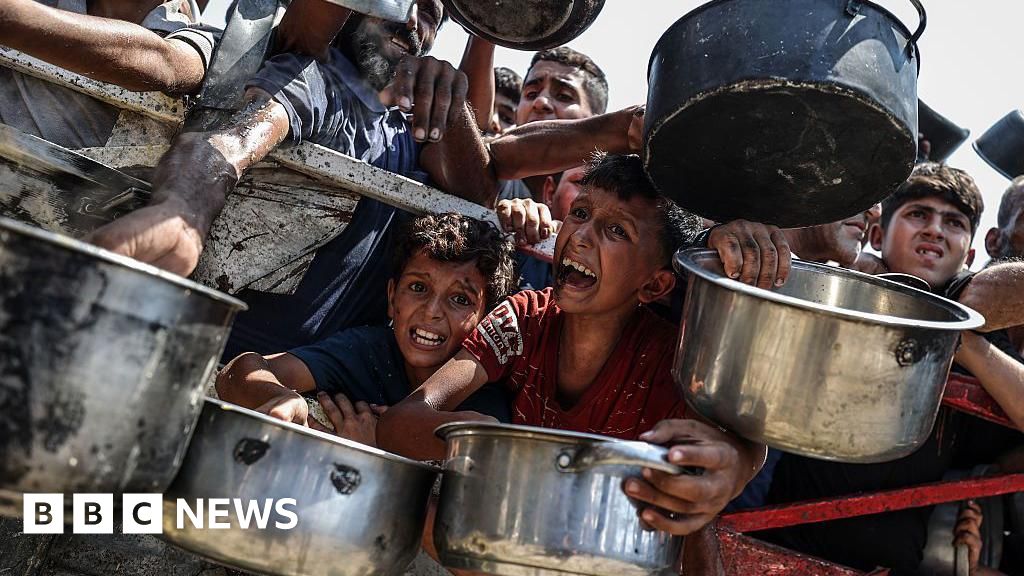
Famine 'currently playing out' in Gaza, UN-backed experts warn share.google

Click to Donate
Every dollar goes to help the people of Palestine
It comes as aid agencies warn Israel's recent measures to increase aid supplies are not enough.
The "worst-case scenario of famine is currently playing out" in the Gaza Strip, UN-backed global food security experts warn.
An alert issued by the Integrated Food Security Phase Classification (IPC) says there is mounting evidence that widespread starvation, malnutrition and disease are driving a rise in hunger-related deaths among the 2.1 million Palestinians there.
"Latest data indicates that famine thresholds have been reached for food consumption in most of the Gaza Strip and for acute malnutrition in Gaza City," it adds.
UN agencies have already warned that there is man-made, mass starvation in Gaza, and reported at least 63 malnutrition-related deaths this month. They have blamed the crisis on Israel, which controls the entry of all supplies to the territory.
Israel imposed a total blockade on aid and commercial deliveries to Gaza at the start of March and resumed its military offensive against Hamas two weeks later, collapsing a two-month ceasefire. It said it wanted to put pressure on the armed group to release its Israeli hostages.
The blockade was partially eased after 11 weeks, after the Israeli government came under pressure from its allies, but the shortages of food, medicine and fuel have worsened.
Israel has insisted there are no restrictions on aid deliveries and that there is "no starvation".
However, it has announced in recent days measures aimed at helping the UN and its partners collect aid from crossings and distribute it within Gaza, including daily "tactical pauses" in military operations in three areas and designated corridors.
The IPC says immediate action must be taken to end the hostilities and allow for an unimpeded, large-scale, life-saving humanitarian response.
The report does not formally classify Gaza as being in a famine, saying that can only be made through analysis that will be conducted "without delay".
The IPC – a global initiative by UN agencies, aid groups and governments – is the primary mechanism the international community uses to conclude whether a famine is happening.
Households are classified as IPC Phase 5 (Catastrophe) if they experience an extreme lack of food, starvation and exhaustion of coping strategies.
The World Food Programme and Unicef expressed alarm that wo famine thresholds – food consumption and acute malnutrition – had been breached in parts of Gaza.
They warned that collecting robust data on the third threshold – starvation-related deaths – under the current circumstances in Gaza was "very difficult as health systems, already decimated by nearly three years of conflict, are collapsing".
On Monday, Gaza's Hamas-run health ministry said that another 14 people had died as a result of malnutrition over the previous 24 hours. That brought the total number of malnutrition-related deaths since the war began to 147, including 88 children, according to the ministry.
The World Health Organization also said on Sunday that there had been 63 malnutrition-related deaths in Gaza this month, including 24 children under five. It noted that the bodies of most of the dead showed "clear signs of severe wasting".
"The unbearable suffering of the people of Gaza is already clear for the world to see. Waiting for official confirmation of famine to provide life-saving food aid they desperately need is unconscionable," said the WFP's executive director, Cindy McCain.
"We need to flood Gaza with large-scale food aid, immediately and without obstruction, and keep it flowing each and every day to prevent mass starvation. People are already dying of malnutrition, and the longer we wait to act, the higher the death toll will rise."
WFP and Unicef said "barely a trickle" of what was needed by Gaza's population had entered since Israel partially eased its blockade, and that more than 62,000 tonnes of aid – the equivalent of approximately 3,100 lorry loads – was required every month just to cover basic humanitarian food and nutrition assistance.
Israel has repeatedly accused Hamas of stealing aid. However, the New York Times cited senior Israeli military officials as saying on Sunday that the military had never found proof that the armed group had systematically stolen aid from the UN.
Reuters news agency also reported last week that internal US government analysis found no evidence of systematic theft by Hamas of US-funded aid.
The Israeli military launched a campaign in Gaza in response to the Hamas-led attack on southern Israel on 7 October 2023, in which about 1,200 people were killed and 251 others were taken hostage.
At least 60,034 people have been killed in Gaza since then, according to the territory's health ministry.
voters
Report Story

Leave Your Comment