
Gaza ceasefire: Palestinians flood back to north Gaza after Israeli pullout middleeasteye.net

Click to Donate
Every dollar goes to help the people of Palestine
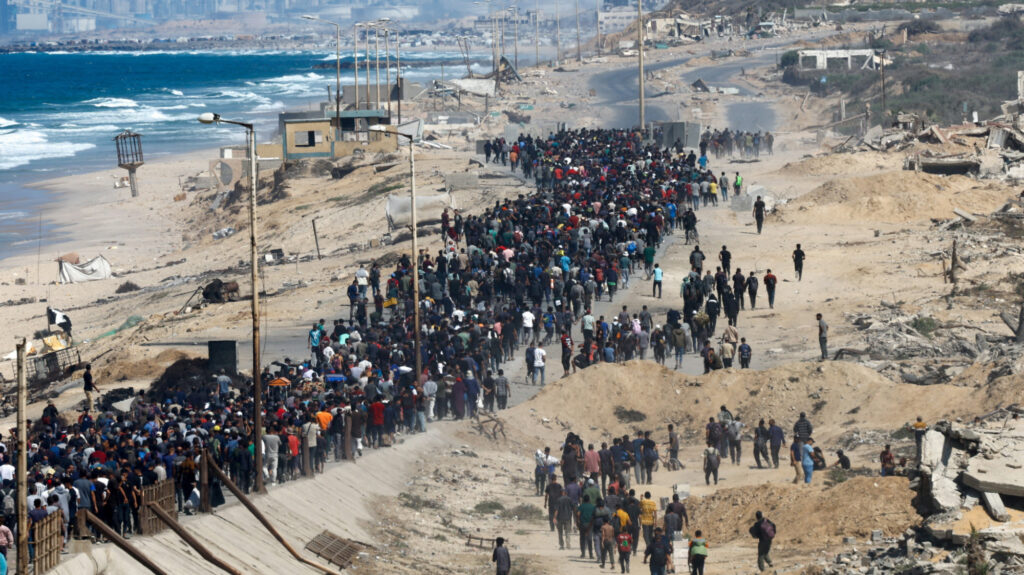
Thousands of Palestinians began returning to northern Gaza on Friday after a ceasefire took effect, following Israel and Hamas’s approval of a deal to "end the war" and exchange prisoners.
The Israeli military said the ceasefire officially began at 12pm local time (9am GMT), following the completion of its withdrawal to agreed-upon lines of the first phase. There was no immediate comment from Hamas.
The Israeli government ratified the agreement on Friday morning, just hours after Hamas announced that a deal had been reached.
Israel’s public broadcaster, Kan, on Thursday published a leaked copy of the agreement's first phase signed in Egypt, which states that the war would “immediately end” once approved by Israel.
The document also specifies that the first step in implementation will be a formal announcement by US President Donald Trump declaring the end of the war in Gaza.
Trump is expected to visit Egypt over the weekend to attend an official signing ceremony, followed by a visit to Israel on Monday.
On Thursday, Hamas chief negotiator Khalil al-Hayya confirmed that the Palestinian movement had also approved the agreement “to end the war”.
He added that the United States and other mediators had provided guarantees that the signing of the deal would mean the war “has ended indefinitely”.
However, Israeli air strikes, artillery fire and gunfire were reported in Gaza City and Khan Younis on Friday morning. No injuries were reported.
Israeli forces also carried out bombings in Gaza on Thursday, after mediators announced a deal had been reached, killing at least eight Palestinians.
By midday on Friday, Israeli tanks had withdrawn from al-Rashid Road, which stretches from southern to northern Gaza and had previously been blocked to prevent displaced people from returning home.
As soon as the troops pulled back, thousands of people were seen flooding back to Gaza City on foot along the road.
The next stage of the agreement is scheduled for midday on Monday – 72 hours after the withdrawal is complete – when 20 living Israeli captives and several bodies are expected to be released. In exchange, Israel will release around 2,000 Palestinian prisoners, including 250 serving life sentences.
However, the list of those to be freed has not yet been finalised. Reports on Thursday indicated ongoing disagreements over the identities of several prisoners, with Hamas pushing for the release of high-profile figures, and Israel objecting.
Among the six reportedly disputed names are Marwan Barghouti, a popular Fatah military leader; Ahmad Sa’adat, head of the Popular Front for the Liberation of Palestine; and senior Hamas figures Hassan Salama, Abdullah Barghouti, Ibrahim Hamed and Abbas al-Sayed.
At least 400 aid trucks are also expected to enter Gaza, though there have been no reports of their arrival so far.
Next stage
The ceasefire deal marks the first phase of the US's so-called "peace plan", with further stages to be negotiated at a later date.
These are expected to include the full withdrawal of Israeli forces from Gaza, the disarmament of Hamas, the deployment of international troops in the territory, and other provisions.
Neither Hamas, Israel, nor the mediators have clarified the timeline for these talks.
It also remains unclear whether the continuation of the ceasefire depends on agreement over the subsequent stages.
The war on Gaza began on 7 October 2023, following a surprise Hamas-led attack on Israel. Hamas cited Israel’s decades-long occupation, growing violations at Al-Aqsa Mosque, the crippling blockade of Gaza, and the mistreatment of Palestinian prisoners as the main reasons for its assault.
The Israeli army's southern command – stationed along the Gaza boundary and tasked with monitoring Palestinians, enforcing the blockade and routinely bombing the enclave – collapsed during the initial hours of the Hamas attack, resulting in widespread chaos.
Palestinians killed at least 1,180 people in the assault, with more than 700 additional deaths reported in the fighting since. Nearly half of Israel’s total death toll is civilians, while the remainder are soldiers.
In response, Israel launched a relentless bombing campaign on the Gaza Strip, followed by a devastating ground invasion that lasted two years, accompanied by a strict siege on the population.
Since then, Israeli forces have killed more than 67,000 Palestinians, over 80 percent of whom are believed to be civilians, according to leaked data from the Israeli military.
The assault also caused widespread famine and led to the destruction or damage of nearly every standing structure in Gaza – including homes, hospitals, schools, mosques and churches.
Numerous international bodies, UN experts and countries have classified Israel’s actions as acts of genocide against the Palestinian people.
voters
Report Story


Leave Your Comment