
Is there momentum for a Gaza deal after Israel-Iran ceasefire? newarab.com

Click to Donate
Every dollar goes to help the people of Palestine
The observers warn that the Gaza file is far more complex, and regional "momentum" may not be enough to overcome entrenched political realities on both sides.
News
MENA
Is there momentum for ending the war on Gaza after Israel-Iran ceasefire?
MENA
5 min read
Sally Ibrahim
Gaza
25 June, 2025
The observers warn that the Gaza file is far more complex, and regional "momentum" may not be enough to overcome entrenched political realities on both sides.
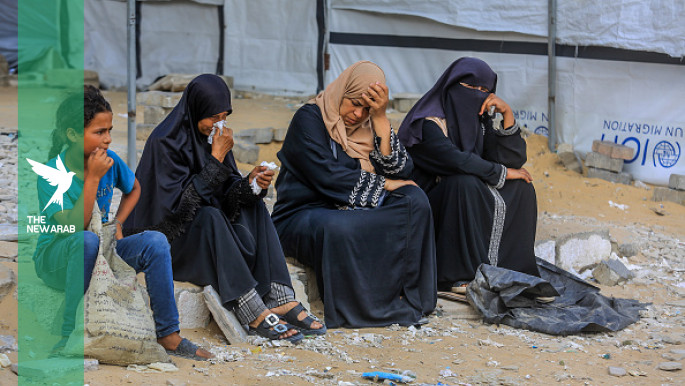
Israeli attacks on Gaza continue
"There is clear recognition that Gaza cannot sustain this war much longer," Palestinian-American businessman Bishara Bahbah said. "Hamas wants a dignified exit, and there's a genuine desire to reach an agreement if key concerns are addressed."
The sudden ceasefire between Israel and Iran has triggered a wave of diplomatic activity across the region, raising cautious hopes that it may help unlock negotiations for a truce in the war-ravaged Gaza Strip.
With more than 20 months of destruction, over 56,000 Palestinians killed, and Gaza's infrastructure on the verge of collapse, the question dominating political corridors is whether this moment of regional de-escalation between Tehran and Tel Aviv can serve as a springboard for ending Israel's genocidal war.
While the ceasefire between Israel and Iran did not directly mention Gaza, the shift in tone has sparked renewed efforts from key mediators, mainly Egypt, Qatar, and the United States, to break the stalemate between Israel and Hamas.
However, observers warn that the Gaza file is far more complex, and regional "momentum" may not be enough to overcome entrenched political realities on both sides.
Back channels, guarantees, and US mediation
Palestinian-American businessman Bishara Bahbah, who has acted as an unofficial go-between for Hamas and the United States, believed momentum is growing among key mediators [Egypt, Qatar, and Washington] to close a deal in Gaza.
News
MENA
Is there momentum for ending the war on Gaza after Israel-Iran ceasefire?
MENA
5 min read
Sally Ibrahim
Gaza
25 June, 2025
The observers warn that the Gaza file is far more complex, and regional "momentum" may not be enough to overcome entrenched political realities on both sides.
Israeli attacks on Gaza continue
"There is clear recognition that Gaza cannot sustain this war much longer," Palestinian-American businessman Bishara Bahbah said. "Hamas wants a dignified exit, and there's a genuine desire to reach an agreement if key concerns are addressed."
The sudden ceasefire between Israel and Iran has triggered a wave of diplomatic activity across the region, raising cautious hopes that it may help unlock negotiations for a truce in the war-ravaged Gaza Strip.
With more than 20 months of destruction, over 56,000 Palestinians killed, and Gaza's infrastructure on the verge of collapse, the question dominating political corridors is whether this moment of regional de-escalation between Tehran and Tel Aviv can serve as a springboard for ending Israel's genocidal war.
While the ceasefire between Israel and Iran did not directly mention Gaza, the shift in tone has sparked renewed efforts from key mediators, mainly Egypt, Qatar, and the United States, to break the stalemate between Israel and Hamas.
However, observers warn that the Gaza file is far more complex, and regional "momentum" may not be enough to overcome entrenched political realities on both sides.
Back channels, guarantees, and US mediation
Palestinian-American businessman Bishara Bahbah, who has acted as an unofficial go-between for Hamas and the United States, believed momentum is growing among key mediators [Egypt, Qatar, and Washington] to close a deal in Gaza.
In a televised interview on Cairo-based al-Ghad on Tuesday, Bahbah revealed that while the Gaza situation is far more complex than the one between Israel and Iran, "there is serious movement" in the talks.
"The environment has changed," he remarked. "There is more focus, more urgency. Mediators want to avoid another prolonged round of war, and the political conditions now might support that."
Bahbah spoke of several proposals on the table and that disagreements between Hamas and Israel have narrowed mainly to "technical points", the phrasing of specific clauses, and agreement on numeric thresholds.
He also revealed that he had met recently with senior Hamas official Ghazi Hamad to discuss the movement's expectations and needs.
"There is clear recognition that Gaza cannot sustain this war much longer," he said. "Hamas wants a dignified exit, and there's a genuine desire to reach an agreement if key concerns are addressed."
Among the proposed terms is a truce that would allow for a massive humanitarian aid entry and the evacuation of critical medical cases to hospitals abroad. "We are serious," Bahbah said in a message to Gaza's civilians. "You are not forgotten."
He stressed that US President Donald Trump is willing to personally guarantee that Israel would not violate the terms of the agreement, a significant development, as Hamas has long demanded binding international guarantees. "For the first time," Bahbah said, "a US president is offering a personal guarantee."
Currently, three major points of contention remain between the parties. According to Bahbah, two of them have been resolved, and the final point is expected to be addressed within days. Egypt, he said, has extended an invitation to an Israeli delegation to return to Cairo, where the agreement’s fate could be sealed.
Meanwhile, Qatari Foreign Ministry spokesperson Majed Al-Ansari confirmed that the Israel-Iran ceasefire has introduced "significant momentum" into ongoing efforts to secure a truce in Gaza. However, he cautioned that the current deadlock remains unresolved.
"We are in contact with all the relevant actors: Hamas, Israel, Iran, and the United States," Al-Ansari said. "The atmosphere is more conducive than before, but the path forward remains complicated."
He refrained from disclosing the exact nature of the obstacles but confirmed that Qatar remains willing to continue its mediation efforts, provided the political will exists on both sides.
Hamas in a weakened position?
While negotiations may be progressing, Hamas's position has been significantly weakened. West Bank-based political analyst Esmat Mansour told The New Arab that Hamas is facing "a narrowing political field" and increasing isolation.
"For the first time, Hamas may be forced to rely entirely on itself," Mansour said. "Iran has stepped back, Hezbollah doesn't want to escalate in the north, and Syria is in no position to intervene."
He explained that Iran's decision to end its confrontation with Israel without linking it to the Palestinian cause signals a new pragmatism.
"Hamas sees this clearly. It knows that the axis of resistance, while supportive rhetorically, will not join it on the battlefield," Mansour added.
He noted that this leaves Hamas confronting both military and humanitarian exhaustion. "They have absorbed massive losses, Gaza's infrastructure is in ruins, and the people are suffering. That creates internal pressure that could push Hamas toward compromise," he said.
However, Mansour emphasised that Hamas will not want to appear as having been defeated. "It needs symbolic political gains, even if the core demands aren't met. That could be recognising its governance role or commitments to post-war reconstruction," he added.
He added that Israeli fatigue is also evident. "Public pressure on Netanyahu is mounting, and the army is questioning the value of continued operations. That shared exhaustion opens a narrow window for diplomacy."
Reham Odeh, a political analyst in Gaza, expects a temporary truce to be reached by July, followed by talks on post-war arrangements. But she warned that Israel may aim to exclude Hamas from any future role in the Strip.
"There are two scenarios," she said to TNA. "Either Hamas agrees to withdraw politically in exchange for guarantees elsewhere, or it resists, and we enter a period of instability no war, but no peace either."
Between symbolism and strategy
For Gaza-based political analyst Hussam al-Dajani, the Iranian ceasefire illustrates that military conflicts are ultimately resolved through political will.
"If Trump and regional powers helped end the Iran-Israel escalation, they could apply the same energy to Gaza," he told TNA.
Al-Dajani argued that both sides are looking for a political exit. "Netanyahu is facing a collapse in public confidence, while Hamas is facing a collapse of infrastructure and morale. Both need a way out," he said.
Still, he warned against placing faith in unwritten guarantees. "Hamas will not accept verbal assurances. Experience has shown that these can be manipulated. Any agreement must be signed, clear, and internationally backed," he added.
He also noted that while Hamas is manoeuvring for political gains, Israel, too, is reluctant to commit to a comprehensive political deal.
"Israel wants security without political concessions. Hamas wants recognition without appearing defeated," he continued.
"The real question," he said, "is not whether momentum exists, but whether it can overcome distrust, trauma, and competing interests."
voters
Report Story


Leave Your Comment